The value is there, but Austria’s museums are barely communicating it
Austria’s museums do a lot for wellbeing and social sustainability, but they hardly ever talk about it. This is shown by our survey, which we conducted for the Austrian Museum Association and presented on Museum Day 2026. The question behind it: What do Austria’s museums do to promote people’s wellbeing and social sustainability—and are they even aware of it themselves? The title already reveals the answer: The value is there. But Austria’s museums are still barely communicating it.
We summarise the most important findings here.
350 Museums, 40 Questions, 12 Dimensions
All approximately 800 registered museums in Austria were contacted; about 350 participated and answered 40 questions between June and September 2026. About half of the museums in Austria are run by volunteers—and this is also true of the sample.
The survey is based on the QWB Lab framework, which comprises twelve dimensions of wellbeing—inspired by the OECD’s “Beyond GDP” initiative. The idea: not to measure value solely by visit numbers.
A Self-Assessment
It’s important to understand that we collected self-assessments. The results therefore show how museums themselves view their contribution—not the measured impact. The figure shows how museums rate their own contribution to all twelve dimensions on a scale from 1 to 10.
Unsurprisingly at the top: Knowledge and Skills at 8.6 and Cultural Competence at 8.4. Over 80% give themselves a score of 8 to 10 in these areas. This reflects the classic self-image of museums. More interesting is what comes right after: the museum as a Safe Place to linger for Wellbeing and Social Connection — areas that do not appear in any museum statistics. Museums are more reserved in their self-assessment when it comes to Health, Work-Life Balance, and Income, .where the average score is 5.2.
Finding 1: Wellbeing has long been a reality
Museums rate their contribution to subjective wellbeing at 7.8 out of 10—yet only just under a quarter offer programs that explicitly promote relaxation or slowing down. Is this a contradiction? No. The open-ended responses show that wellbeing happens constantly in museums—during group singing, on the walking path between buildings, in conversation, in moments of quiet, and while immersing oneself in an exhibition. It’s just not called that. Nearly two-thirds have free lounge areas with no obligation to purchase, and one-fifth already collaborate with healthcare facilities.
So the message is: Not every museum needs a yoga class. It’s about consciously shaping what already exists and making it visible.
Finding 2: Practice before formalisation
Practice is more advanced than its formal institutionalisation.
- Participation: Three-quarters of museums collaborate with local organisations. But only a little over a quarter has advisory boards or programs developed in collaboration with the public.
- Safety: Museums see themselves as safe places—more than a quarter respond along the lines of: “Our museum is also such a safe place.” However, only 23% have incorporated emotional safety into their concept.
- Sustainability: One-third have a strategy—but nearly 60% do not make their measures visible to the public at all.
In other words: A lot is being done, but little of it is strategically anchored or actively communicated.
Finding 3: Impact is rarely measured
Perhaps the most strategically important finding concerns the data foundation. Only 12% of Austrian museums regularly survey their audiences. While over 70% of museums offer opportunities for feedback, a guestbook does not constitute an impact measurement. At the same time, there is considerable interest: Nearly three-quarters would use data on their institution’s social value in public relations, and about half would use it internally and in communications with funding agencies.
So it’s not a lack of will—it’s a lack of data, terminology, and simple tools.
Conclusion
Austria’s museums are already making a significant contribution to wellbeing and social sustainability. They don’t need to create this value from scratch. The task is a different one: recognising, measuring, highlighting, and further developing this value—not through new, complicated reporting requirements, but with just a few additional, impact-oriented indicators. And: Not every museum has to excel in every area. A regional museum can be a gathering place, an art museum a place of tranquillity, and an open-air museum a bridge between nature and community. Together, this forms a wellbeing network.
We would like to extend our heartfelt thanks to the Austrian Museum Association for their cooperation.
We invite you to:
Share your thoughts: What aspect of your museum’s value has gone untold so far?
Read the full report by Sabine Doolin and Sabine Fauland in “neues museum” 26/3-4.
Contact us if you have any questions, or if you are interested in conducting a similar survey and/or in measuring not only self-assessments but also visitors’ perspectives.
The value is there, but Austria’s museums are barely communicating it
Austria’s museums do a lot for wellbeing and social sustainability, but they hardly ever talk about it. This is shown by our survey, which we conducted for the Austrian Museum Association and presented on Museum Day 2026. The question behind it: What do Austria’s museums do to promote people’s wellbeing and social sustainability—and are they even aware of it themselves? The title already reveals the answer: The value is there. But Austria’s museums are still barely communicating it.
We summarise the most important findings here.
350 Museums, 40 Questions, 12 Dimensions
All approximately 800 registered museums in Austria were contacted; about 350 participated and answered 40 questions between June and September 2026. About half of the museums in Austria are run by volunteers—and this is also true of the sample.
The survey is based on the QWB Lab framework, which comprises twelve dimensions of wellbeing—inspired by the OECD’s “Beyond GDP” initiative. The idea: not to measure value solely by visit numbers.
A Self-Assessment
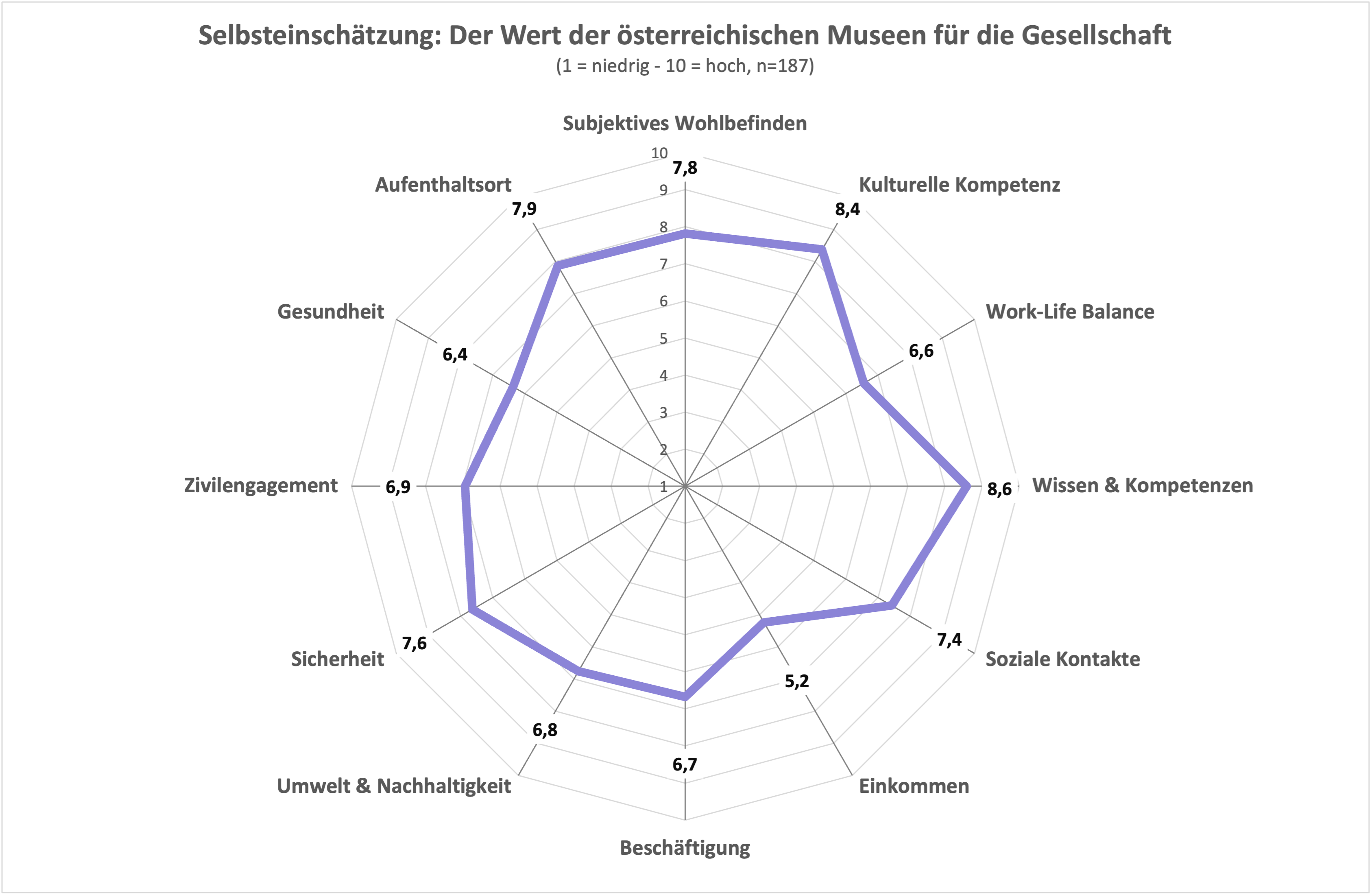
It’s important to understand that we collected self-assessments. The results therefore show how museums themselves view their contribution—not the measured impact. The figure shows how museums rate their own contribution to all twelve dimensions on a scale from 1 to 10.
Unsurprisingly at the top: Knowledge and Skills at 8.6 and Cultural Competence at 8.4. Over 80% give themselves a score of 8 to 10 in these areas. This reflects the classic self-image of museums. More interesting is what comes right after: the museum as a Safe Place to linger for Wellbeing and Social Connection — areas that do not appear in any museum statistics. Museums are more reserved in their self-assessment when it comes to Health, Work-Life Balance, and Income, .where the average score is 5.2.
Finding 1: Wellbeing has long been a reality
Museums rate their contribution to subjective wellbeing at 7.8 out of 10—yet only just under a quarter offer programs that explicitly promote relaxation or slowing down. Is this a contradiction? No. The open-ended responses show that wellbeing happens constantly in museums—during group singing, on the walking path between buildings, in conversation, in moments of quiet, and while immersing oneself in an exhibition. It’s just not called that. Nearly two-thirds have free lounge areas with no obligation to purchase, and one-fifth already collaborate with healthcare facilities.
So the message is: Not every museum needs a yoga class. It’s about consciously shaping what already exists and making it visible.
Finding 2: Practice before formalisation
Practice is more advanced than its formal institutionalisation.
- Participation: Three-quarters of museums collaborate with local organisations. But only a little over a quarter has advisory boards or programs developed in collaboration with the public.
- Safety: Museums see themselves as safe places—more than a quarter respond along the lines of: “Our museum is also such a safe place.” However, only 23% have incorporated emotional safety into their concept.
- Sustainability: One-third have a strategy—but nearly 60% do not make their measures visible to the public at all.
In other words: A lot is being done, but little of it is strategically anchored or actively communicated.
Finding 3: Impact is rarely measured
Perhaps the most strategically important finding concerns the data foundation. Only 12% of Austrian museums regularly survey their audiences. While over 70% of museums offer opportunities for feedback, a guestbook does not constitute an impact measurement. At the same time, there is considerable interest: Nearly three-quarters would use data on their institution’s social value in public relations, and about half would use it internally and in communications with funding agencies.
So it’s not a lack of will—it’s a lack of data, terminology, and simple tools.
Conclusion
Austria’s museums are already making a significant contribution to wellbeing and social sustainability. They don’t need to create this value from scratch. The task is a different one: recognising, measuring, highlighting, and further developing this value—not through new, complicated reporting requirements, but with just a few additional, impact-oriented indicators. And: Not every museum has to excel in every area. A regional museum can be a gathering place, an art museum a place of tranquillity, and an open-air museum a bridge between nature and community. Together, this forms a wellbeing network.
We would like to extend our heartfelt thanks to the Austrian Museum Association for their cooperation.
We invite you to:
Share your thoughts: What aspect of your museum’s value has gone untold so far?
Read the full report by Sabine Doolin and Sabine Fauland in “neues museum” 26/3-4.
Contact us if you have any questions, or if you are interested in conducting a similar survey and/or in measuring not only self-assessments but also visitors’ perspectives.